Imagine you have been waiting for a laptop to drop in price. A few months ago, that meant opening a browser every few days, visiting the same product pages, and comparing numbers manually. The search repeated until the timing felt right.
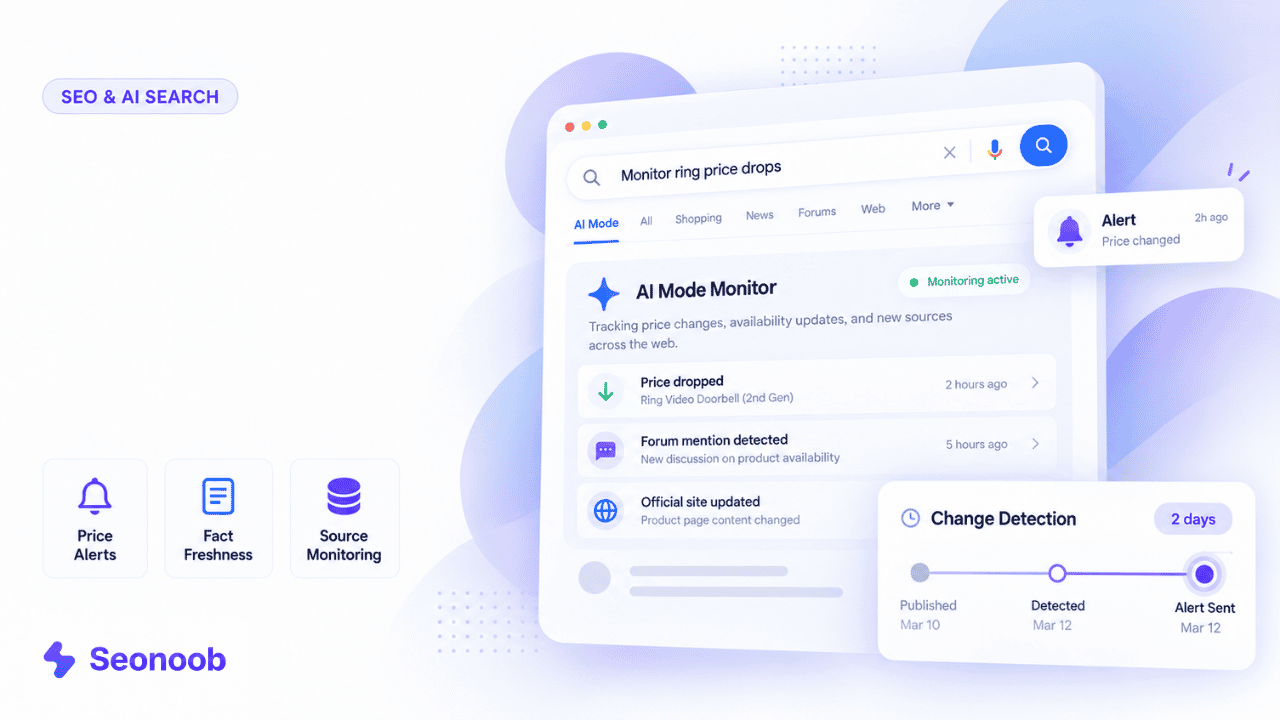
Now, Google offers a different approach. Instead of searching again yourself, you can ask Google AI Mode to watch the product and notify you when the price changes.
The search does not need to repeat. Google continues looking after you leave.
On September 29, 2026, Google confirmed that this monitoring capability was expanding globally to all users, not just subscribers on Pro or Ultra plans. According to Search Engine Land’s coverage of the announcement, Google said AI Mode could monitor changing information across websites, forums, social posts, real-time data sources, and its Shopping Graph, which it described as containing more than 60 billion products.
That is the development worth paying attention to.
Google Search Is Learning to Keep Looking, Even After You Leave
For most of search’s history, visibility meant one thing: appearing in the right place when someone typed a query. The search happened, results appeared, the user either clicked or did not, and that was the interaction.
AI Mode’s monitoring agents add a second visibility window. A business may publish an updated price or a new event date today, but a customer could encounter that information days later through an AI-generated monitoring update rather than through a new manual search.
This does not replace the original search moment. It extends what happens after it.
What Exactly Are Google AI Mode Monitoring Agents?
An AI monitoring agent is best understood as a standing task rather than a one-time question.
A normal search asks Google something and expects an immediate answer:
“Where can I buy this product?”
A monitoring task gives Google an ongoing instruction:
“Tell me when this product is back in stock.”
Google can then continue checking relevant sources and surface updated information when the conditions are met. The user does not need to initiate a new search for each update.
What kinds of things can Google monitor?
Google’s September announcement described several categories the monitoring capability is designed to support:
- Product price drops and restocking events
- New restaurants or pop-up businesses opening nearby
- Local activities and seasonal events
- Other changing information available from supported sources
Where does the information come from?
Google’s monitoring capability can draw on multiple source types, including websites, forums, social posts, and product information from its Shopping Graph. The company has not specified its monitoring schedule or confirmed which individual sources are checked and at what frequency.
The Big SEO Shift: Search Doesn’t Always End After One Query
The table below captures the difference between the two search experiences:
| Traditional search | AI-assisted monitoring |
|---|---|
| User searches for a product | User asks Google to watch a product |
| Google returns results | Google monitors changing information |
| User clicks a website | Google may deliver an update later |
| User may return to search again | User may not need to search again |
| Visibility depends on the moment of the query | Visibility may also depend on monitoring updates |
From a marketing perspective, this creates a set of questions that standard rank tracking was not built to answer:
- Was the business included in Google’s monitoring results when the change was detected?
- Was the displayed price or date accurate?
- Did Google reference the official website as the source?
- Was the information current at the point the update arrived?
- Were competitors recommended instead?
These are emerging questions, not evidence that keyword rankings are becoming irrelevant. Traditional SEO metrics still matter. Monitoring agents add a second layer of AI-generated exposure that sits alongside conventional search results rather than replacing them.
Measuring AI search visibility beyond website clicks has become increasingly relevant as the gap between appearing in an AI response and receiving a website session widens. Monitoring updates may widen that gap further.
Why Fresh Content Could Become More Important for AI Search
Businesses already need accurate information for conventional search performance. If a product page shows the wrong price, shoppers are misled and conversion suffers. The principles are not new.
What AI monitoring adds is a downstream consequence. If Google’s monitoring agent detects outdated source information while watching a product or event, the update it surfaces may be based on that incorrect or stale data. The customer’s experience is shaped by what Google found, not necessarily by what the business intended to communicate.
The important concept here is factual freshness, not simply publishing new content more often. Changing a publication date without updating the underlying facts does not improve the information quality Google encounters.
For ecommerce websites
The information most relevant to monitoring agents tends to be the information most likely to change:
- Product prices
- Inventory availability
- Product variants in stock
- Discounts and promotional periods
- Delivery timeframes
- Product discontinuations
Example: A jewelry store reduces the price of a necklace. If Google’s monitoring agent identifies the updated price, a customer who set up a price-drop alert for that product could receive a relevant notification. Whether every price change triggers a notification depends on factors Google has not disclosed in detail.
For training providers and event businesses
Courses and events are well suited to monitoring use cases because dates and availability change in ways that directly affect purchasing decisions:
- Course start dates and session availability
- Remaining seat counts
- Venue or location changes
- Registration deadlines
Example: Someone interested in a leadership course could ask Google to alert them when sessions in their city become available. An outdated page still showing a completed course date could lead to an inaccurate update.
For local businesses
Local businesses publish information that changes regularly and matters to nearby customers:
- Opening hours
- New locations or service areas
- Seasonal services
- Special offers and temporary availability
Could Google’s Monitoring Agents Change How Customers Discover Products?
Discovery may happen days after the initial search
A consumer might begin researching a product on Monday and receive a monitoring update on Friday. The awareness moment and the potential purchase moment are separated by days rather than seconds. Businesses thinking only about visibility at the instant a query is entered may be missing part of the picture.
Third-party information may influence recommendations
Google’s described sources include forums and social platforms, not only the business’s own website. A monitoring update could therefore include information originating from a product review thread, a community discussion, or a comparison website.
For businesses, this creates a practical reason to monitor what third-party sources say about pricing, availability, and product details. An inaccurate description on an external forum could potentially influence what a monitoring agent surfaces to a customer.
An AI update may not create an immediate website visit
A customer receiving a monitoring notification may note the information, decide they are ready to purchase, and complete that action later in a way that does not appear in session-based analytics. GA4 organic sessions and click-through data cannot fully capture the role an AI-delivered update played in a conversion that happens through a direct visit or branded search the following day.
These are potential implications of the feature as announced. Google has not provided conversion-rate, click-through, or revenue-impact data for monitoring agents as part of this announcement.
What Does This Mean for Structured Data and Product Feeds?
Structured data and product feeds help search engines interpret information about a business, its products, and its services in a machine-readable format.
Whether these directly influence how quickly AI Mode detects a change is not confirmed by Google’s announcement. But keeping this information accurate and synchronized remains good practice regardless of any specific monitoring effect.
Keep product structured data accurate
Review Product and Offer structured data for accuracy, particularly:
priceandpriceCurrencyavailabilityurl- Product identifiers where applicable
Ensure the values in structured data match what users can see on the page itself. Discrepancies between structured data and on-page content are a source of confusion for both users and search systems.
Keep Google Merchant Center information synchronized
For eligible ecommerce websites with product feeds in Google Merchant Center, ensure that prices and inventory status in the feed accurately reflect the live website. A feed showing a previous price after an update has gone live is a straightforward accuracy problem worth resolving.
Update important page information consistently
When a price, event date, or promotional offer changes, update the primary page and any applicable structured data or feed at the same time. Staggered updates mean different systems may hold different information temporarily.
This is presented as a reasonable hypothesis for businesses to test rather than a confirmed mechanism. Google has not established in its announcement that Merchant Center or schema updates directly accelerate AI Mode monitoring alerts.
A Practical 14-Day Experiment to Test Google’s AI Monitoring
Rather than making general assumptions about how monitoring agents behave, businesses can run a small, controlled experiment to observe the feature directly.
Step 1: Select five subjects that change over time
| Test subject | Information to monitor |
|---|---|
| Ecommerce product | Price |
| Product with limited stock | Availability |
| Training course | Next session date |
| Local service | Promotional offer |
| Seasonal activity | Event date or availability |
Choose subjects for which the relevant AI Mode monitoring task is available in your market.
Step 2: Establish a baseline
Before making any changes, record the initial on-page information, the date and time the monitoring task was created, the exact monitoring request submitted, whether Google initially identifies the correct information, and which sources it references.
Step 3: Update one fact
Make one legitimate, clearly documented change to the source page. Reduce a genuine product price or publish a confirmed new course date. Update any relevant structured data and product feeds at the same time.
Step 4: Record what happens over 14 days
| Metric | What to measure |
|---|---|
| Published change | Date and time the fact changed on the source page |
| First observed update | When Google first displayed the new fact |
| Monitoring notification | Whether an update was delivered |
| Notification delay | Time elapsed from publication to notification |
| Official source included | Yes or No |
| Third-party sources | URLs or domains appearing alongside the update |
| Accuracy | Correct, outdated, or incorrect |
| Feed or schema status | Updated or not applicable |
Step 5: Compare the results
After 14 days, review the data with a set of focused questions:
- How long did it take the update to appear in AI-generated results?
- Did a monitoring notification arrive?
- Did Google cite the official website as the source?
- Did outdated third-party information persist alongside the corrected information?
- Did different categories (price vs. event date vs. availability) behave differently?
This is an experiment framework for businesses to run themselves, not a completed Seonoob study with published results. Five examples cannot establish causation. A larger, controlled follow-up would be needed to determine whether Merchant Center feeds or structured data changes meaningfully affect how quickly monitoring agents detect updates.
How Should Businesses Prepare for Persistent AI Search?
1. Identify information customers are likely to want monitored. Start with facts that change frequently and directly influence purchasing decisions: prices, availability, event dates, and service hours.
2. Keep important facts accurate and current. Prioritize product pages, pricing pages, availability status, event listings, and public business information. Factual accuracy matters for both traditional search and AI-generated responses.
3. Review third-party information. Identify inaccurate descriptions and outdated listings on external review sites, directories, and comparison platforms. These sources may contribute to what AI monitoring surfaces about the business.
4. Monitor how AI platforms describe the business. Track important product, category, pricing, and availability queries to understand what AI systems are currently saying, which sources they cite, and where discrepancies exist. Understanding how AI search engines select and cite information is relevant here, as the same source-selection principles that apply to AI Overviews are likely to influence monitoring updates.
5. Measure AI visibility separately from traffic. Record mentions, citations, and accuracy in AI-generated results rather than relying solely on organic sessions as the success metric. Monitoring updates may drive awareness and eventual conversions that do not appear in standard session-based reporting.
What This Could Mean for AI Visibility Tracking Tools Like Seonoob
Traditional SEO monitoring focuses primarily on keyword rankings and organic traffic. Those signals remain useful, but they do not capture whether a brand appears in AI-generated answers, whether the citation is accurate, or whether a competitor is being recommended instead.
AI monitoring agents may eventually add a third dimension to this measurement challenge: how quickly does an AI system reflect a real-world change made on a business’s website?
A future capability worth building would record:
- The original value of a tracked fact
- The date the fact changed on the source page
- The updated source URL
- When the new value first appeared in an AI response
- Whether outdated values persisted after the update
- Whether the official source received a citation or whether a third-party source was preferred
This represents a future product opportunity rather than a capability currently available in AI search visibility and rank tracking tools today. But as monitoring agents become a more standard part of how users interact with Google, the gap between publishing accurate information and having AI systems reflect that information accurately will become a measurable variable worth tracking.
Final Takeaway: SEO May Need to Optimize for the Next Update, Not Just the Next Search
Return to the laptop example from the opening.
A customer looking for a price drop does not necessarily search again every few days. They ask Google to watch the product and wait for an update. Whether they eventually purchase may depend on what that update says, how accurate it is, and whether it points to the right source.
That creates a new consideration for businesses. Their information needs to remain accurate, understandable, and accessible not just at the moment of the original search, but at any point Google may reference it in a monitoring update days later.
The September 29 announcement confirms an expansion of AI Mode’s monitoring capability. It does not yet provide data on how often updates are delivered, how quickly Google detects changes, or what effect the feature has on traffic or conversion rates.
The practical takeaway is that content freshness, source accuracy, and AI visibility measurement deserve greater attention as search becomes more persistent. Businesses that maintain accurate information and monitor how AI systems describe them will be better positioned for a search environment where the query is not always the last step.