Imagine searching Google for advice on choosing an engagement ring.
An AI Overview appears with a clear explanation of diamond shapes, setting styles, and what different price points typically look like. Several websites contributed to that answer. Their links are there, somewhere in the response.
But what if one of those links appeared directly beside the sentence you were reading? What if a particularly useful article was highlighted at the very top of the answer, before you had to scroll through anything?
That is the direction Google is moving in.
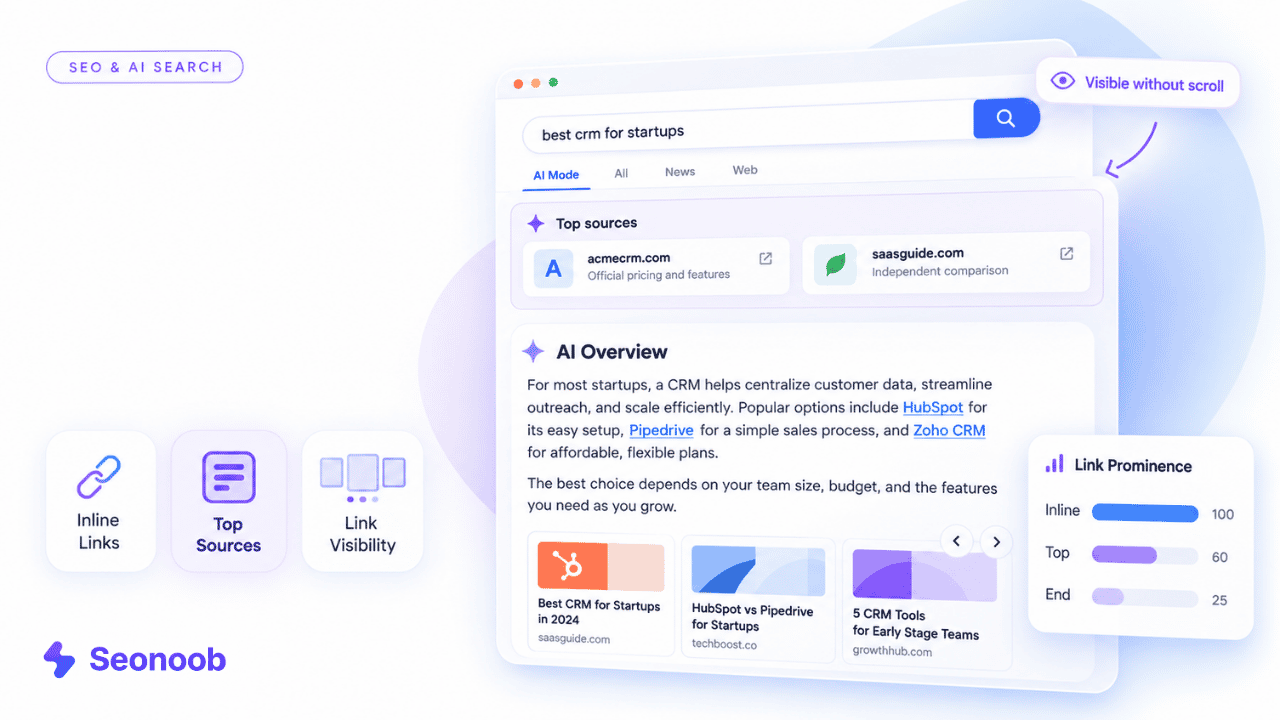
On October 15, 2026, Google announced a set of changes designed to make source links more visible throughout AI Mode and AI Overviews. The updates include more frequent inline links placed higher in answers, a tested top-source section, expanded article carousels, enhanced related links with image thumbnails, and experiments with clickable creator and publisher names. The announcement was published on the Google Official Blog.
The key point upfront: Google is changing how users discover websites inside AI-generated answers. Whether those changes will increase publisher traffic is a separate question, and one Google has not yet answered with data.
What Exactly Did Google Announce on October 15?
Google’s announcement describes five distinct changes to how links appear within AI search experiences. Their rollout status varies, so it is worth keeping confirmed changes separate from features still in testing.
| Change | Status | What it means |
|---|---|---|
| More inline links | Rolling out | Links appear more frequently and higher in AI answers |
| Dedicated top-source section | Testing | Relevant pages may appear prominently at the top |
| Timely-article carousels | Expanding | News and current articles gain visibility in more markets |
| Enhanced related links | Being introduced | More prominent links with image thumbnails |
| Clickable creator names | Testing | Video creators and publishers can link to Search profiles |
1. More links directly inside AI answers
Rather than grouping all source references into a separate citations panel, Google has increased how often it places links inline within the AI-generated response itself. A relevant source can now appear as a clickable link embedded in the specific sentence or paragraph it supports.
Google specifically states it has increased inline-link presence and is positioning these links higher in responses more frequently. The change means a source website could be discoverable at the point a user is reading the relevant information, rather than requiring them to seek out a footnote or expand a separate sources section.
2. A new section for especially relevant websites
Google is testing a dedicated section designed to highlight particularly useful pages near the top of an AI response. The feature is especially relevant for navigational searches and tasks where an official website is clearly the appropriate destination, such as booking an appointment, checking a price, or reading product specifications directly from the source.
This feature is in testing and is not yet universally available.
3. More prominent news and article carousels
Google is expanding timely-article carousels to additional countries and languages. These carousels highlight news coverage and current articles within AI-generated responses, giving publishers producing time-sensitive content an additional surface within AI search results.
News publishers, industry media, and websites producing original research on current topics should pay attention to this expansion, particularly as it becomes available in more markets.
4. Related articles with thumbnails
Some links appearing at the end of AI responses will receive more prominent visual treatment, including image thumbnails alongside the article title and source name. Whether more visually prominent presentation leads to higher engagement is a reasonable hypothesis; Google has not published data confirming that outcome.
5. Clickable creator and publisher names
Google is also testing links from creator and publisher names on AI Mode video results through to their Search profiles. This gives video creators and media publishers a route for users to discover more of their work directly from an AI-generated video result, without needing to navigate elsewhere.
Why This Matters: Not All AI Citations Are Equal
Most AI visibility tracking today measures a binary outcome: was a domain or URL cited in an AI response?
That tells you something. But it misses an important dimension of how that citation was actually presented.
Consider two websites cited in the same AI answer.
Website A appears as a prominent inline link embedded within the first paragraph of the response. A user reading the answer encounters that link naturally, while reading.
Website B appears in a related-articles section at the bottom of the same response, below a long answer and an image carousel.
Both websites are cited. Both would register as a citation in a standard tracking report. But the user experience is meaningfully different, and the likelihood that someone engages with each link is likely different too.
Google’s announcement has not quantified that difference. But it has confirmed that link placement and presentation within AI answers are features worth designing for, which suggests they are features worth measuring.
Understanding how AI search engines select and cite sources is the foundation for building tracking that captures more than just citation presence. The distinctions that already matter, between a cited domain, a cited page, a brand mention, and a direct link, now have an additional layer: where in the response the link appears and whether it is visible without user action.
| Citation characteristic | What it tells us |
|---|---|
| Citation presence | Was the website cited at all? |
| Citation placement | Where did the link appear in the response? |
| Citation format | Inline, top-source, carousel, or end link? |
| Link visibility | Is it visible without scrolling or expanding? |
| Citation context | Why was the source referenced? |
| Destination URL | Which specific page received the link? |
Could More Prominent Links Bring More Traffic From AI Search?
The intuitive case for optimism is straightforward. If a user sees a relevant source link while reading an AI-generated explanation, they may be more inclined to visit the original page. A top-source section that highlights official websites could make it easier for users who want to complete a task to reach the right destination without extra effort.
But this remains a hypothesis rather than a proven outcome.
What Google has confirmed: Interface changes designed to make source links easier to discover within AI-generated answers.
What Google has not confirmed:
- How much publisher click-through rates will change
- Whether the new link placements generate meaningfully more traffic
- Which industries or content types benefit most
- How frequently the top-source section will appear in live results
- Whether links in more prominent positions generate significantly more engagement than less visible ones
This is a development worth measuring carefully rather than an announcement to celebrate as a confirmed traffic recovery. Why AI search visibility and website traffic need separate measurement remains relevant: exposure inside an AI answer and a resulting website session are not the same outcome, and the relationship between them is still being established through observation.
How Should SEOs Track Link Visibility Inside AI Overviews?
The most practical response to Google’s changes is to expand what citation monitoring actually records. The concept worth introducing here is AI Citation Prominence Tracking: moving beyond whether a website is cited to capturing how the citation is presented.
Step 1: Build a fixed list of important search queries
Select 25 to 50 queries that represent the searches most relevant to the business. Cover informational, commercial, comparison, branded, and high-intent searches. Include queries where being cited as a source would be valuable, not just queries the website currently ranks for.
Fixing the query list matters. Comparing results over time requires checking the same queries consistently.
Step 2: Capture the full AI-generated response
Record the complete answer, including all source displays, expanded citation panels where available, and screenshots. Screenshots create a timestamped record of what the interface showed and when.
Step 3: Record how each citation appears
| Metric | Recording method |
|---|---|
| AI Overview present | Yes or No |
| Brand mentioned | Yes or No |
| Official site cited | Yes or No |
| Link treatment | Inline, top-source, carousel, or end link |
| Position in response | Top, middle, or bottom |
| Visible without scrolling | Yes or No |
| Thumbnail included | Yes or No |
| Citation context | Brief note on why the source was referenced |
| Destination URL | Exact page that received the link |
| Date and time checked | When the result was recorded |
Also note device type, location, and whether the response was in its collapsed or expanded state. These factors can affect which links appear and how they are displayed.
Step 4: Compare visibility over time
Run the same searches weekly and look for changes in where the website appears, whether competitors receive more prominent placements, and which specific pages Google chooses to cite. A single screenshot is not a stable data point. Patterns across multiple weeks are more meaningful.
A Simple Experiment: Does Citation Placement Influence Visibility?
Here is a 30-day test that produces directional observations without requiring access to controlled click-level data.
Select 30 to 50 search queries where AI Overviews appear regularly. Capture results at least weekly under consistent device and location conditions. Group each observed citation into one of four categories:
- Prominent inline links within the AI response body
- Dedicated top-source links, where the test feature is available
- Article carousel appearances
- End-of-response related links
Measure citation frequency, the category of placement, whether the citation is visible without expanding the response, and which specific URLs are cited. Separately monitor any AI referral traffic in Google Analytics and relevant Search Console performance data over the same period.
Working hypothesis: Pages receiving more prominent link placements may generate more opportunities for user engagement than pages appearing only in less visible citation areas.
What ordinary website analytics cannot tell you: whether a specific click came from a particular inline link versus a related-articles section. Traffic comparisons in this experiment will be directional. Confirming the hypothesis at the individual-citation level would require click-level measurement that standard analytics does not currently provide for AI-generated results.
What Kind of Content Might Benefit From These Changes?
Based on the display formats Google announced, certain content types appear better suited to the new link treatments. This is based on content characteristics rather than confirmed placement criteria Google has published.
Pages that directly answer specific questions
Educational articles, how-to guides, and technical explanations that provide clear, focused answers to specific queries are natural candidates for inline source links. When an AI answer is explaining a concept and references a supporting source, the link appears beside the explanation it supports.
Official product and service pages
Accurate product detail pages, appointment booking pages, pricing information, and policy pages may be strong candidates for the top-source section, particularly on navigational searches where a user wants to reach an official destination.
Original research and timely industry news
Data studies, surveys, and articles covering current developments have a natural fit with timely-article carousels. The expansion of carousels to more countries and languages makes original, time-sensitive content more relevant to markets where the feature was not previously shown.
Video content with identifiable creators
Publishers and creators producing original video content should ensure their authorship and channel identity are clearly associated with their work. The clickable-creator-name feature, once available, could make publisher identity a discovery mechanism within AI video results.
The data-backed factors associated with AI brand visibility connect directly to these content types: topical relevance, original evidence, and a clear brand presence across the web all contribute to whether and how AI search references a source.
What Should Website Owners Do Now?
1. Review pages already cited in AI answers. Identify which pages appear, how they are currently presented, and what questions they help answer. This creates a baseline before the new display changes become more widely available.
2. Make important information easy to find. Publish clear, direct answers to common questions and keep critical details, such as prices, availability, and contact information, accurate and accessible. Inline links appear beside the information they support, so the clarity of that information matters.
3. Invest in genuinely useful original content. Practical examples, current information, verifiable research, and first-hand expertise are more likely to be selected as sources than generic articles covering the same ground as dozens of other pages.
4. Pay attention to article images and creator attribution. Make sure images associated with articles are relevant and high quality. For video content, ensure publisher and creator identities are clearly associated with the work.
5. Expand AI visibility reporting. Move beyond counting whether the domain appears in AI answers. Begin recording citation type, position, and visibility as separate data points. Google’s announcement signals that these distinctions are becoming part of how AI search is designed to work.
None of these steps guarantee top-source placement. Google has not published criteria for obtaining those positions.
What This Means for AI Visibility Platforms Like Seonoob
Standard AI citation tracking records whether a brand or domain appeared in an AI-generated answer. That is a useful signal. Google’s October announcement introduces a natural next measurement question: not just whether the citation appeared, but how prominently.
A future reporting capability worth building would record:
- Citation placement category (inline, top-source, carousel, end link)
- Whether the link was visible without scrolling or expanding
- The position of the citation within the response
- The context in which the source was referenced
- The exact destination URL cited
- Competitor citation prominence on the same query
- How each of these changes week over week
A derived Citation Prominence Score could summarize these dimensions into a single trackable number, provided the underlying metrics remain visible and the score is clearly presented as a measurement construct rather than anything Google itself assigns.
This is a proposed future direction for SEO and AI visibility tracking with Seonoob, not a feature currently available. But the logic is straightforward: if Google is designing AI search to distinguish between a basic citation and a prominently displayed one, measuring that distinction becomes part of understanding how visible a brand actually is.
Final Takeaway: Being Cited Is Good. Being Seen May Be Better.
For years, SEOs tracked where websites appeared in the ten blue links.
AI search introduced a different challenge: whether a website was included as a source inside an AI-generated answer, and whether the brand name appeared in the text.
Google’s October 15 announcement suggests a further distinction is becoming relevant.
Where does the citation link appear? Is it embedded in the response where a user is reading, or tucked at the bottom after the answer is complete? Is it visible immediately, or does the user need to scroll or expand a panel to find it?
The data on traffic impact does not yet exist in published form. Whether more prominent links produce meaningfully more clicks is something the industry will observe over the coming months.
What is clear is that citation placement is now a feature Google is actively designing for. That makes it a signal worth measuring rather than a detail to ignore while continuing to count citations as though all placements were equivalent.
The practical response is not to abandon conventional SEO measurement. It is to extend it, adding the placement and visibility dimensions that Google has now made a visible part of how AI search presents sources.