Someone searches your company name.
For years, the expectation was simple. Your homepage ranked first, followed by social profiles, review platforms, and maybe a few directory listings. You owned the results page for your own name.
That is still largely true. But there is now an additional layer that sits above or alongside those organic results on a growing number of searches: an AI-generated summary of your business, drawn from sources across the web.
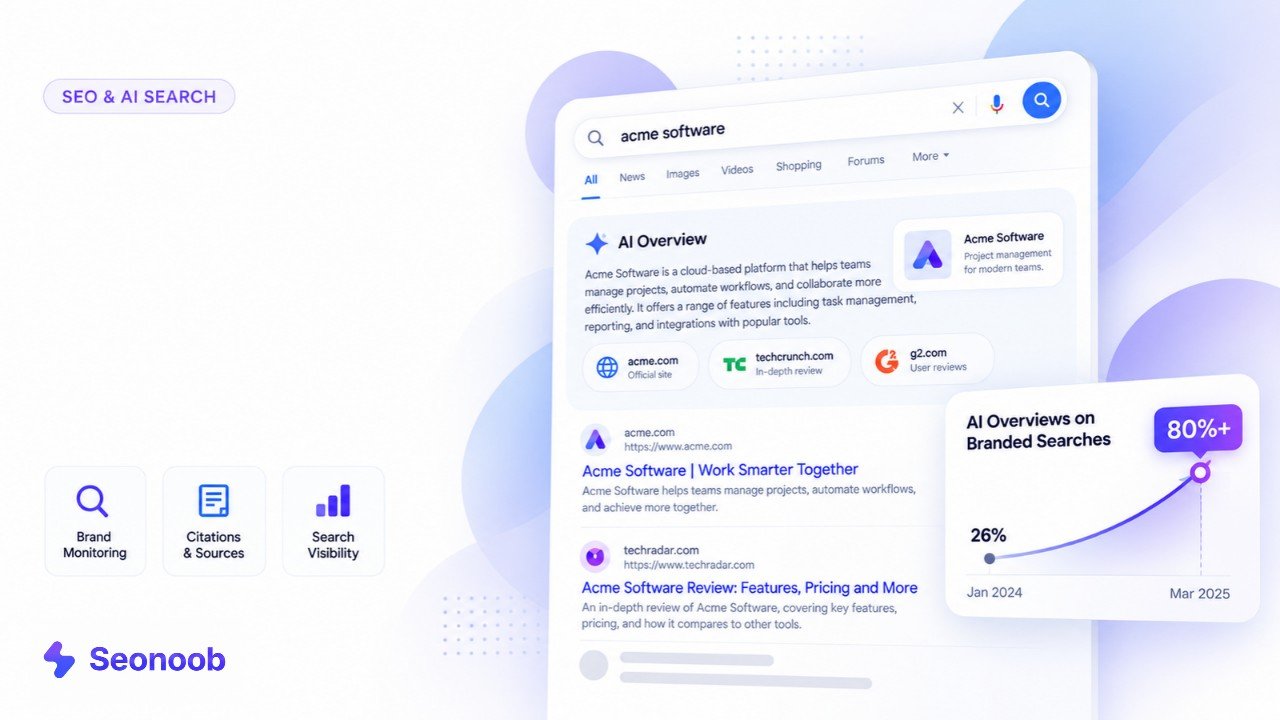
In September 2026, that layer became significantly more common on branded searches. Data from DemandSphere shows that AI Overview presence on tracked branded queries moved from roughly one in four at the start of the month to more than four in five by the end.
What Changed With Branded Searches in September?
DemandSphere tracks branded keywords daily through its DemandMetrics platform and records whether a Google AI Overview appeared for each query. The dataset covers all markets and all devices.
For most of September, AI Overview presence on branded queries held relatively steady, in the high-20% to mid-30% range. Then, in the final five days of the month, the numbers shifted sharply:
| Date | AI Overview presence on tracked branded queries |
|---|---|
| September 1, 2026 | 26.12% |
| September 18, 2026 | 57.43% |
| September 26, 2026 | 69.21% |
| September 27, 2026 | 90.48% |
| September 28, 2026 | 80.23% |
| September 29, 2026 | 82.06% |
The more revealing sequence is the five-day run from September 25 through September 29: 29.98%, 69.21%, 90.48%, 80.23%, 82.06%. That acceleration, not the end figure alone, is what makes the data worth paying attention to.
Important caveats before drawing conclusions:
The DemandSphere figures combine all markets and all devices. AI Overview presence does not mean the brand appeared inside the answer. The company’s own website being cited is a separate outcome, not guaranteed by presence alone. DemandSphere did not measure click-through rates. And Google has not announced a specific branded-search AI Overview expansion. This is observational data describing what DemandSphere measured, not a confirmed platform-wide policy change.
Why AI Overviews on Brand Searches Matter More Than They First Appear
The traditional branded search journey looked like this:
User searches brand name → sees official website at position one → visits website.
The AI Overview changes where in that journey Google introduces information. It now looks more like this:
User searches brand name → reads an AI-generated description → decides whether to visit.
The shift is not necessarily about ranking. A company can still rank first organically while Google summarizes information about its pricing, reviews, products, policies, reputation, and even competitors before the user clicks anything.
Consider a fictional example. Someone searching for Acme Software may see an AI Overview describing what the platform does, sourced from review sites, directories, and third-party comparisons. Searches like “Acme Software pricing,” “Acme Software complaints,” or “Acme Software alternatives” may produce very different summaries, drawing on entirely different sources.
The brand still ranks first. But Google has already told the searcher something about it.
That is why measuring AI visibility beyond website traffic has become a separate discipline from traditional rank tracking. Traffic and visibility are no longer the same metric on branded queries any more than they are on informational ones.
Ranking First for Your Brand Is No Longer the Whole Story
Traditional branded SEO focused on a specific set of outcomes. AI search introduces an additional layer alongside them.
| Traditional branded SEO | AI-era branded SEO |
|---|---|
| Are we ranking first? | Is an AI Overview appearing? |
| What pages rank below us? | What does the AI answer say? |
| What is our branded CTR? | Is our brand mentioned? |
| Are reviews positive? | What sentiment does AI present? |
| Does our site dominate the SERP? | Is our website cited as a source? |
Both sets of questions matter. Neither replaces the other. But the second column requires a different kind of monitoring than keyword ranking reports can provide.
AI Overview Presence, Brand Mentions, and Citations Are Three Different Metrics
One of the more common mistakes in early AI visibility reporting is treating these three outcomes as equivalent. They are not.
1. AI Overview presence. Did Google show an AI Overview for the query? For “ExampleBrand reviews,” the answer may be yes. That tells you the feature appeared. It tells you nothing else.
2. Brand mention. Did the AI-generated answer actually name the company or product? An AI Overview can appear for a branded query without clearly discussing the brand being searched. The answer may focus on the category instead, or give prominence to a competitor.
3. Official-domain citation. Did Google cite the company’s own website as a supporting source? This is a separate question again. The answer to a branded query may instead be sourced from Reddit, review websites, news publishers, comparison sites, directories, or forums.
A brand should not report these three metrics as though they were the same outcome.
AI Overview presence is not the same as a brand mention. A brand mention is not the same as an official website citation.
Understanding how AI citations and brand mentions differ is the starting point for building a branded AI visibility tracking process that is actually useful.
Build a Branded AI Search Audit
The starting point is not to test only the company name. Build a structured set of branded queries that reflects how real users search.
Group 1: Core brand searches Brand name, brand plus product name, product names on their own, common misspellings.
Group 2: Reputation searches Brand plus reviews, brand plus complaints, brand plus legitimacy-related terms, brand plus customer service.
Group 3: Commercial searches Brand plus pricing, brand plus cost, brand plus features, brand plus plans, brand plus discount.
Group 4: Comparison searches Brand plus alternatives, brand versus named competitor, is-it-worth-it queries, best alternatives to brand.
Group 5: People searches For companies where executives, founders, lawyers, doctors, trainers, or specialists influence buying decisions: person name, person plus company, person plus specialty, person plus reviews.
The goal is to build a query set that reflects the brand’s actual search landscape, not a generic template applied to every business.
What to Record for Every Branded AI Search
A simple tracking framework makes the audit repeatable and comparable over time.
| Field | What to record |
|---|---|
| Query | Exact branded search term |
| AI Overview | Present or absent |
| Brand mentioned | Yes or no |
| Official site cited | Yes or no |
| Other cited domains | Domains Google used as sources |
| Sentiment | Positive, neutral, or negative |
| Accuracy | Correct, partially correct, or incorrect |
| Competitors mentioned | Brands appearing alongside yours |
| Key claims | Pricing, features, reputation, policies |
| Date checked | When the result was recorded |
Screenshots are also useful. AI-generated results change, and a screenshot creates a timestamped record of what appeared and when.
Pay Particular Attention to Factual Errors
An AI Overview pulls information from multiple sources across the web. That makes certain types of information especially worth verifying.
Check AI-generated answers against the brand’s actual current pricing, product availability, service locations and coverage, refund and returns policies, guarantees, business hours, product features and specifications, executive and team information, company descriptions (especially if the brand has pivoted or rebranded), and review or comparison content that may now be outdated.
If inaccurate information appears repeatedly in AI answers for branded queries, investigate where Google is sourcing it from. The fix is rarely a single content update. It is more often a consistency problem: information that differs between the official website, third-party directories, old press releases, and review platforms.
Look at Which Websites Google Trusts for Information About Your Brand
The question worth asking is: who is helping AI explain your own company?
Review the sources cited in branded AI Overviews. Look for patterns across review platforms, industry publications, comparison sites, directories, news websites, community platforms, and YouTube. Note whether your own domain appears.
If third-party sources are repeatedly selected over the official website, investigate why. A third-party page may answer the specific query more directly than your own content does. Your pricing page may be unclear or out of date. A product page may not explain a key feature in plain language. A community discussion may contain information your site does not cover at all.
Understanding the data-backed factors associated with AI brand visibility can help prioritize which gaps to address first, whether those are on your own site or across third-party sources.
Do Not Assume an AI Overview Automatically Means Lost Traffic
The September DemandSphere data tells us AI Overview presence on branded queries increased significantly. It does not tell us that branded click-through rates dropped by any specific amount, that sales decreased, or that users stopped visiting official websites.
DemandSphere did not measure clicks. Neither did the separate testing by SEO analyst Chris Long that found AI Overviews appearing for 93 of 100 major brands he checked. Neither study measured what users did after seeing an AI-generated summary.
A branded AI Overview could reduce a click by answering a question immediately. It could equally reinforce the brand, confirm to a user that they have found the right company, or surface the brand to a user who would not have visited directly. The actual effect likely varies by query type, industry, and what the AI answer contains.
Treating AI Overview presence as automatically harmful understates the situation. So does treating it as harmless. The honest answer is that more granular data is needed to understand the traffic effect, and it should not be assumed either way.
What Brands Should Do Now
1. Establish a branded-query benchmark. Build the query set and record current AI Overview visibility before the landscape shifts further.
2. Separate the metrics. Track AI Overview presence, brand mention, and official domain citation as three distinct data points. A single “AI visibility score” that combines them will obscure the information that matters.
3. Fix factual inconsistencies. Keep pricing, policies, product descriptions, company details, and structured information consistent across the entire web presence, not just the official website.
4. Strengthen third-party brand signals. Monitor which sites Google cites. Look for legitimate opportunities to improve review profiles, industry coverage, and independent discussion where it is missing or inaccurate.
5. Repeat the audit regularly. AI-generated results are dynamic. A one-time check establishes a baseline. Periodic repetition shows which direction things are moving.
How Seonoob Can Help Track the Shift
Traditional rank tracking confirms whether a website still holds position one for its own brand name. It does not reveal what appears inside an AI-generated answer, which sources Google used, or how the brand is described.
Seonoob’s AI visibility and SEO tracking helps marketers monitor brand mentions, citations, and prompt-level visibility alongside traditional SEO performance, so that branded AI exposure becomes a measurable signal rather than a reporting blind spot.
The practical goal is to separate AI Overview presence, brand mention, and official-domain citation within reporting, and to track how each of those moves over time.
Final Takeaway: Your Brand Search Results Are Becoming a Reputation Channel
For years, brands could treat their own name as relatively safe search territory. If you ranked first for your company name, branded search was largely under control.
AI Overviews complicate that assumption.
The September DemandSphere data does not prove that every branded search will soon produce an AI-generated answer. But the movement from around 26% to above 80% within one month is a strong enough signal that branded AI visibility deserves its own monitoring process, separate from rank tracking and separate from organic traffic reports.
The new branded-search question is not simply: “Do we rank first?”
It is: “When someone searches for us, what does Google tell them before they visit us?”